
Architect

Tom Doak

Tom Doak, born in 1961, is an American golf course architect whose minimalist, ground-up approach has made him one of the most influential designers of his generation. After studying the great British links on a Cornell traveling scholarship and working under Pete Dye, he founded Renaissance Golf Design and built his reputation on sites left largely untouched, letting natural terrain dictate strategy. His work at Pacific Dunes in Oregon, Ballyneal in Colorado, Barnbougle Dunes in Tasmania, and Cape Kidnappers in New Zealand established him internationally, and he is also known as a prolific writer on design, notably through his book The Anatomy of a Golf Course. Doak's firm continues to design and restore courses worldwide, favoring firm, fast, walkable golf over heavy earthmoving.

Courses on BogeyMap
18
States
13
Avg LooperScore
84.9
Highest rated
Bandon Dunes Golf Resort - Pacific Dunes

Biography

Tom Doak, born in 1961, is an American golf course architect whose minimalist, ground-up approach has made him one of the most influential designers of his generation. After studying the great British links on a Cornell traveling scholarship and working under Pete Dye, he founded Renaissance Golf Design and built his reputation on sites left largely untouched, letting natural terrain dictate strategy. His work at Pacific Dunes in Oregon, Ballyneal in Colorado, Barnbougle Dunes in Tasmania, and Cape Kidnappers in New Zealand established him internationally, and he is also known as a prolific writer on design, notably through his book The Anatomy of a Golf Course. Doak's firm continues to design and restore courses worldwide, favoring firm, fast, walkable golf over heavy earthmoving.

Where the work is: OR · WI · FL · MI · NC · CO · SC · TX · VA · WA · DE · NE · IL
Courses on BogeyMap (18)

Resort18 holes

Bandon Dunes Golf Resort - Pacific Dunes

Bandon, OR

Pacific Dunes is a Tom Doak design at Bandon Dunes Golf Resort on the southern Oregon coast, opened in 2001 as the resort's second course. The land was already dunes and shore pine, and much of the routing works with what was there, including sand blowouts left as bunkers rather than shaped into them. It plays as a par 71 and breaks convention in a few ways. The 10th and 11th are consecutive par 3s, and the back nine carries three par 5s. The routing touches the ocean bluff at the 4th, the 10th and 11th, and again at the 13th, and the holes inland from the water sit among 60-foot dunes and gorse. Like every course at the resort, Pacific Dunes is walking only, with caddies available. The wind off the Pacific is the main variable, and the course is short enough by modern numbers that the challenge is almost entirely about controlling the ball in it. Pacific Dunes golfers can carry the day into the resort's main-lodge dining area, where the Gallery and Puffin Bar provide a relaxed setting for drinks and food. McKee's Pub is another lively option nearby, with Pacific Northwest beer, single-malt scotch and a fireside patio.

ArchitecturePure GreensVibes

Role: architect

Resort18 holes

Sand Valley Golf Resort - The Lido

Nekoosa, WI

The Lido at Sand Valley Golf Resort in Wisconsin opened in 2023 and is unlike anything else in American golf: it is a reconstruction of a course that no longer exists. C.B. Macdonald's original Lido Club, built on Long Island in 1917 on sand pumped from a bay, was lost during the Second World War. The rebuild was made possible by Peter Flory, who spent years assembling a digital model of the original from aerial photographs, Macdonald's written plans and period accounts. Tom Doak, with Brian Schneider and Brian Slawnik, then built that model into the sand barrens at Nekoosa, hole for hole and contour for contour. The result includes Macdonald's template holes and several concepts that had disappeared from golf entirely, among them the Channel hole, where golfers choose how much of a diagonal carry to take on off the tee. It is walking only, and the scale of the greens and bunkers reflects 1917 design rather than modern practice.

ArchitecturePure GreensWalkable

Role: restoration of C.B. Macdonald original

Resort18 holes

Bandon Dunes Golf Resort (Old Macdonald)

Bandon, OR

Old Macdonald is the fourth course at Bandon Dunes Golf Resort, designed by Tom Doak and Jim Urbina and opened in 2010. It is a tribute to C.B. Macdonald, the architect who brought the ideas of British links golf to America, and the routing draws on the template concepts he used repeatedly. Golfers play a Redan, a Biarritz, an Alps, a Punchbowl, a Short and others, all reinterpreted for the Oregon dunes rather than copied. The greens are enormous, some of the largest in American golf, and the fairways run together with almost no defined edges, so the course looks and plays wider than the others at the resort. There are very few trees, which leaves the holes fully exposed to the coastal wind. The ground is firm, the approaches are open in front, and running the ball onto greens is often the better play. Like the rest of the resort, it is walking only. Ghost Tree Grill sits just beyond Old Macdonald's 18th green and takes its name from the landmark on the third hole. The Pacific Northwest steakhouse and raw bar has walls of windows, a large indoor-outdoor bar, a courtyard and a fire pit, making it the most course-connected gathering place at the resort.

ArchitecturePure GreensVibes

Role: architect

Resort18 holes

Streamsong Resort - Blue

Bowling Green, FL

Streamsong Blue is an 18-hole, par-72 Tom Doak design at Streamsong Resort in Bowling Green, built on the site of a former phosphate mine. Doak and Bill Coore jointly routed the resort's first 36 holes across the reclaimed land, and Blue takes the towering sand dunes, deep water ponds and elevation change that is unusual for the region. Native grasses frame large, irregular bunkers spilling off elevated dune features, giving the course a rugged, discovered-rather-than-built feel. The par-3 seventh, played across water to a dune-set green, is its most talked-about hole. Blue measures roughly 7,200 yards from the back tees. Pub 59 is inside the shared Red and Blue clubhouse, overlooking the putting green and Bye Hole. Pub fare, 16 draft beers and a wall of sports screens make it Streamsong's most direct casual stop after a round on Blue.

ArchitectureVibesWalkable

Role: architect

Public18 holes

Forest Dunes Golf Club (The Loop)

Roscommon, MI

The Loop at Forest Dunes in Roscommon, Michigan, is a Tom Doak design that opened in 2016. It is a reversible course: one set of 18 greens and fairways played clockwise one day as the Black Course and counterclockwise the next as the Red. Building it that way forced particular choices. Greens are open in front from both directions, bunkers sit away from the direct line so they work on either routing, and there are almost no forced carries. The result is two genuinely different tests from the same ground. The resort posts which direction is in play on a given day. The course sits on sandy soil in the Huron National Forest, next to the original Forest Dunes course.

ArchitectureWalkable

Role: architect

Resort18 holes

Sand Valley Golf Resort - Sedge Valley

Nekoosa, WI

Sedge Valley opened in 2024 at Sand Valley in Nekoosa, Wisconsin, and was designed by Tom Doak. It was built deliberately short, playing to a par 68 at well under 6,000 yards, as a counterweight to the longer courses at the resort. The model was British heathland golf. Corridors are tighter than elsewhere on the property, the ground is covered in low sedge and scrub, and the emphasis is on shot placement and iron play rather than driving distance. There are more short par 4s and par 3s than a standard rotation. It is walking only, open to resort guests, and shares the same sandy soil as the resort's other courses.

ArchitectureWalkableResort Access

Role: architect

Golfer photo of Pinehurst No. 10 in Aberdeen, NC
Looper · BogeyMap reviewer
Resort18 holes

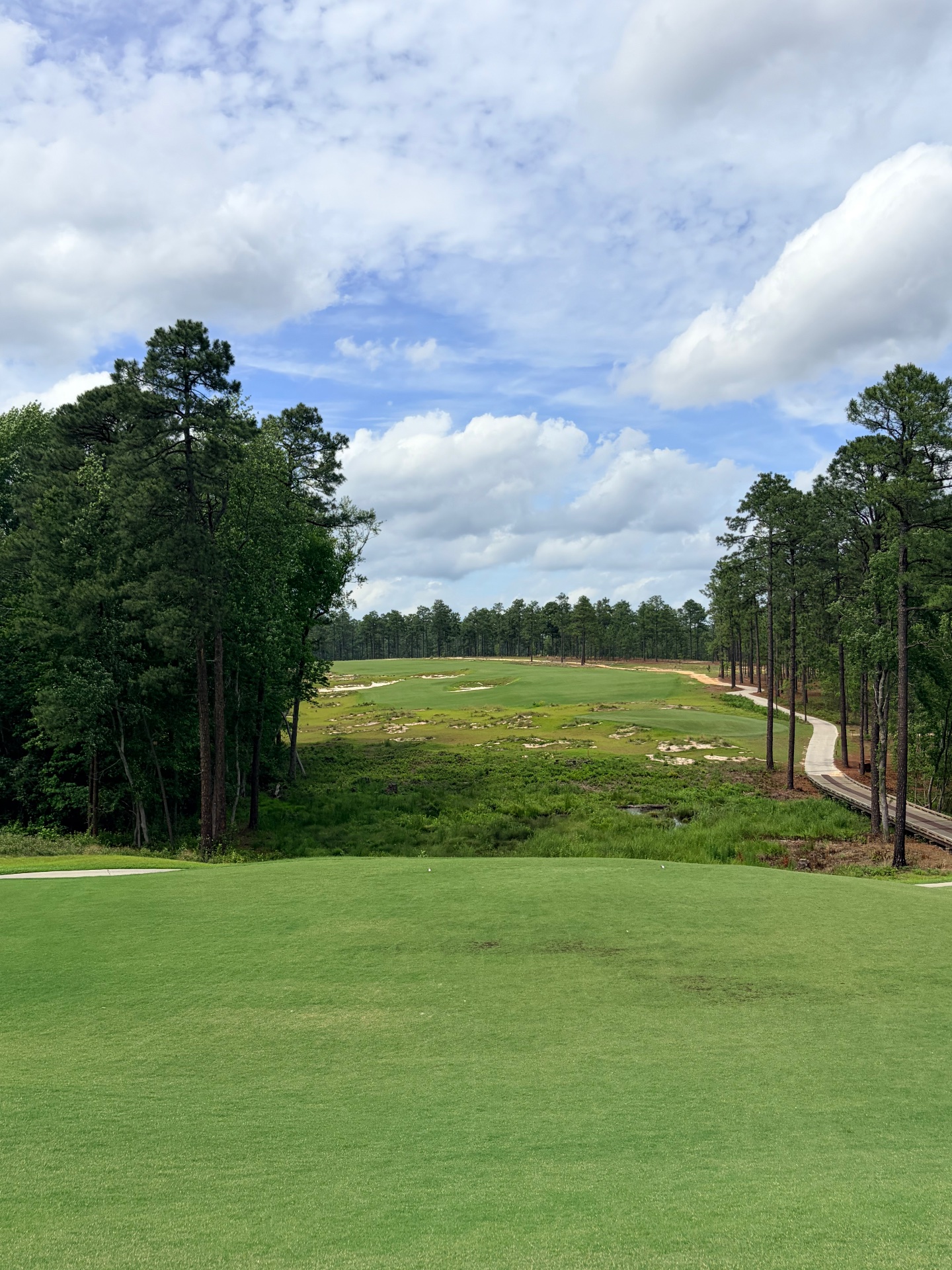
Pinehurst No. 10

Aberdeen, NC

Tom Doak's newest Sandhills masterpiece

Pure GreensVibesWalkable

Role: architect

Public18 holes

CommonGround Golf Course

Aurora, CO

CommonGround Golf Course in Aurora, Colorado, is a public course designed by Tom Doak. Doak's minimalist approach, influenced by British Isles links, shaped the land's natural contours. He transformed the site into a fun, challenging course using strategic feature placement and "width that matters." The course is known for its organic feel and commitment to affordable, natural outdoor sport. The 2nd hole, a 144-yard par-3, provides a view of downtown Denver.

Hidden GemVibesWalkable

Role: architect

Resort18 holes

Legends Golf & Resort (Heathland)

Myrtle Beach, SC

Heathland is the links-inspired member of the three-course Legends Golf Resort complex in Myrtle Beach. Tom Doak designed the par-71 layout as an American interpretation of golf in the British Isles, using broad, mostly treeless corridors, exposed wind, deep bunkers and rough tight to the fairways to create the challenge. The open ground gives golfers room to choose lines, but the best angle into each green often depends on avoiding the course's strategically placed hazards. Highlanders Double Eagle Tavern is the main-clubhouse stop for Heathland, Moorland and Parkland, serving breakfast and lunch with a full bar and televisions. The separate Ailsa Pub is a Scottish-inspired evening gathering place in the resort's Turnberry Park neighborhood, giving golf groups another place to continue the day after the clubhouse closes.

VibesAprès Golf

Role: architect

Public18 holes

Rawls Course at Texas Tech

Lubbock, TX

The Rawls Course was built for Texas Tech on a flat West Texas cotton field in Lubbock, giving Tom Doak a blank canvas he took on immediately after finishing Pacific Dunes. His crew moved roughly 1.3 million cubic yards of earth to manufacture a rumpled, sandy-scrub landscape on ground that had no natural features at all. Constant South Plains wind is the defining challenge, working with firm turf and strategic bunkering. It opened in 2003, funded by an eight-million-dollar gift from alumnus Jerry Rawls, and serves as home to the university's golf programs. It is the rare manufactured course that reads as found ground.

Vibes

Role: architect

Public18 holes

Murphy Creek Golf Course

Aurora, CO

Murphy Creek Golf Course, home of "the Homestead at Murphy Creek," is a city-owned course on the eastern edge of Aurora, Colorado. Its prairie-links setting includes wide fairways, native rough and farm-themed buildings, including an old barn and vintage equipment placed around the grounds. The course was designed by Kenneth Kavanaugh and opened around 2000, combining modern strategic design, large bunkers and expansive greens with a rustic, rural atmosphere. It hosted the 2008 U.S. Amateur Public Links Championship. Murphy Creek operates as a public, municipal course under the City of Aurora golf system, with a driving range, practice facilities and an on-site tavern.

Role: architect

Public9 holes · Short

The Schoolhouse Nine

Sperryville, VA

The Schoolhouse Nine is a 9-hole public course in Sperryville, Virginia, made up entirely of par 3s between 85 and 171 yards, par 27 over about 1,206 yards. It opened in July 2015 as the first course in Rappahannock County and was designed by Mike McCartin, who worked as a shaper for Tom Doak. Construction moved almost no earth: only the greens and tees were disturbed. The holes wander through native wildflower meadows along the Thornton River, past the stone ruins of the old Smoot Tannery, in the foothills of the Blue Ridge. Check-in is inside the historic Sperryville schoolhouse next to Headmaster's Pub, and pull carts come with a membership.

WalkableShort CourseDog Friendly

Last verified 2026-09-16

Role: architect

Resort18 holes

Suncadia Resort - Prospector Course

Cle Elum, WA

Prospector Golf Course is an 18-hole course at Suncadia Resort near Cle Elum, Washington, in the Cascade foothills. It was the first course at the 54-hole resort, opened in 2004 and designed by the Palmer Course Design Company, founded by Arnold Palmer and Ed Seay. The course is set within a pine and fir forest with strategically placed lakes and ponds, and rolling, well-bunkered fairways create risk and reward options for stronger players while remaining playable for beginners. The 10th hole drops about 125 feet in elevation from tee to landing area with views of the Cascade Range. Greens on the course are known for subtle, difficult-to-read breaks. Prospector operates as a resort course, open to the public and resort guests, with a golf shop and practice range. It plays to a par of 72 and measures 7,112 yards from the championship tees.

Role: architect

Public18 holes

Frog Hollow Golf Club

Middletown, DE

Frog Hollow Golf Club is an 18-hole, par-72 public course in Middletown, in the fast-growing southern stretch of New Castle County. The layout plays over open, gently rolling ground and has become one of the busier public tee times between Wilmington and Dover.

Role: architect

Private18 holes

Dismal River Golf Club (Main)

Mullen, NE

Dismal River Golf Club (Main/White Course) is a private, 18-hole, par-72 golf club near Mullen, Nebraska, in the Sandhills, designed by Jack Nicklaus and opened in 2006 as his first course in the state. The links-style layout plays to 7,353 yards from the back tees with a 74.9 rating and 143 slope, routed along the Dismal River and Big Horseshoe Hill on the property. It was Nicklaus' 250th design credit in a career of nearly 40 years at the time of opening.

Not yet ratedWalkableResort Access

Last verified 2026-09-17

Role: architect

Private18 holes

Dismal River Golf Club (Ranch)

Mullen, NE

Dismal River Golf Club (Ranch) is in Mullen, NE. This course, also designed by Tom Doak, complements its sister course. It has a distinct layout that emphasizes strategic shot-making and natural beauty.

Not yet ratedWalkableResort Access

Role: architect

Private18 holes

Onwentsia Club

Lake Forest, IL

Onwentsia started as a seven-hole course on Senator Charles B. Farwell's lawn. Charles B. Macdonald built the first nine in 1895, and Herbert J. Tweedie with James and Robert Foulis added the second nine in 1898. Tom Doak and Bruce Hepner have done renovation work since. It hosted the 1906 U.S. Open and remains one of the older North Shore clubs, with racquets and a full social program alongside the golf.

Not yet ratedHistoric

Role: renovation

Private18 holes

Shoreacres

Lake Bluff, IL · Location not mapped

Shoreacres in Lake Bluff, Illinois was founded in 1916 by a group led by Stanley Field, a nephew of Marshall Field, along with members from the nearby Onwentsia Club. Construction was delayed by World War I, and architect Seth Raynor completed the design in 1921 on a flat plateau cut through by wooded ravines that feed toward Lake Michigan. The par-71 course includes Raynor's characteristic template holes such as a Redan, Biarritz, Eden and Road hole, with a distinctive three-hole stretch playing across, down into, and back out of a ravine. David Adler designed the clubhouse, rebuilt after a 1983 fire, and Tom Doak's firm led a restoration of the course in the early 2000s.

Not yet ratedHistoric

Role: restoration